President Kang Kee-hoon says new Songdo campus will serve as gateway before international students move into majors at Seoul and Yongin campuses
Behind each university’s global ambitions are choices about what to preserve, what to develop and where to go next. In “World Class,” The Korea Herald interviews leaders of Korean universities about the strengths they are cultivating and the futures they envision. — Ed.
The president of Hankuk University of Foreign Studies sees Songdo as a place to put the university’s decades of expertise in languages and regional studies to work in international education, AI research and industry partnerships.
HUFS plans to open its third campus in 2027 in Songdo, Incheon, a planned city that has become a center for international business, higher education and biotech research. The university’s other two campuses are in Seoul and Yongin, Gyeonggi Province.
The new campus will include an undergraduate division for international students who have yet to choose a major.
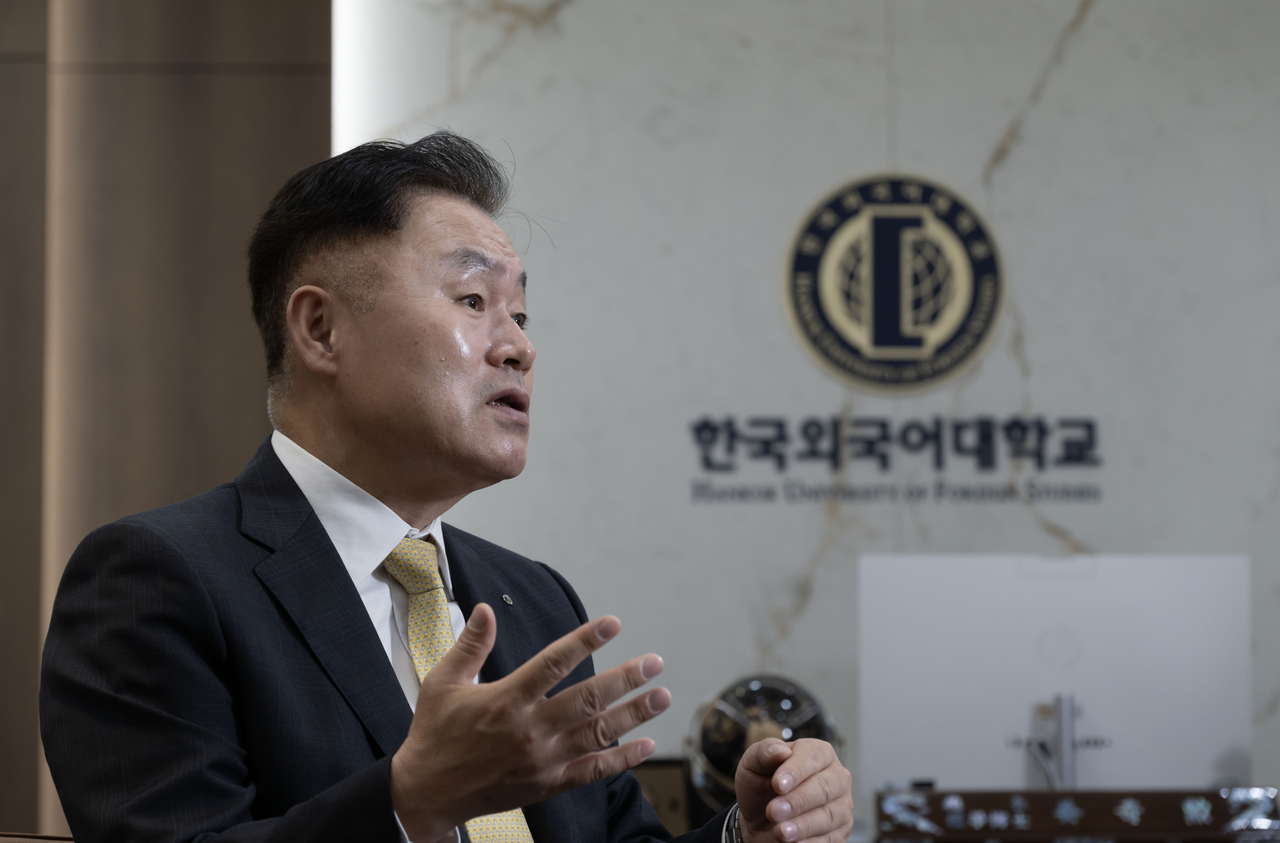
“Songdo has strengths that come from its proximity to Incheon Airport, its position as a global gateway and its status as an international city where a global bioscience cluster, international organizations and global companies are concentrated,” HUFS President Kang Kee-hoon said in an interview with The Korea Herald on Sept. 30.
“We seek to transform Songdo Campus into a new globalization hub that connects global talent with industries expanding into the world,” Kang said.
Students in the new division would generally spend their first year studying Korean and exploring different academic fields. Those who need more time could continue exploring into their second year before choosing a major.
“Once students have built the ability to decide on their major, whether after the first year or the second year, they can find the major they want at either the Global Campus or the Seoul Campus,” Kang said.
Three campuses, one university
Kang sees HUFS’ three campuses as playing distinct but complementary roles.
The Seoul Campus is envisioned as a “global agenda hub,” drawing on the university’s traditional strengths in languages, area studies, diplomacy, security, trade and international relations.
The Global Campus in Yongin will serve as a “future growth engine,” combining language and regional expertise with artificial intelligence, data, semiconductors, biotechnology, climate studies and other advanced fields.
Songdo, meanwhile, will become a practice-oriented international education base connecting global talent with industry. The university also plans to link Songdo’s biotechnology ecosystem with HUFS’ strengths in international business and foreign languages.
Asked whether a separate unit for international students could deepen the separation between international and Korean students, Kang said the Songdo model was designed to do the opposite.
Rather than creating a four-year enclave for international students, HUFS wants the campus to provide a foundation before students move into the university’s existing academic structure.
One idea under consideration is to designate a “lecture-free day,” tentatively on a Wednesday or Thursday, when no classes would be held at Songdo.
Students could instead travel to Seoul or Yongin on university-provided transportation to attend or explore classes there.
The system would allow students to experience different departments before choosing a major and, Kang hopes, prevent the three campuses from developing as isolated academic communities.
“Physically, the campuses are separate,” he said. “But in reality, we want to make them all connected.”
HUFS already allows students to cross disciplinary and campus boundaries. Kang cited a student majoring in Dutch studies who added semiconductor studies as a second major and later joined Dutch chip equipment maker ASML as an example of the combinations he wants to encourage.
From recruiting students to ensuring their success
HUFS teaches 45 foreign languages and has more than 3,000 international students. It also has 145 international faculty members from 43 countries and maintains ties with 616 universities and 73 other institutions across 102 countries, according to university data.
Kang says that those numbers alone are becoming less useful as a measure of global competitiveness.
“Quantitative expansion can be achieved in a relatively short period of time through financial investment and efforts to recruit students,” he said.
“What other universities cannot quickly match is the expertise HUFS has accumulated over more than 70 years in foreign studies, including regional, language and literary expertise,” he added.
Kang wants to move HUFS from what he calls the “internationalization of scale” toward “qualitative internationalization” and eventually “smart internationalization,” integrating artificial intelligence and data into education, research, international cooperation and university administration.
He also wants the university to focus more closely on what happens after international students arrive. Kang describes the approach through five steps: recruit, educate, support, employ and connect.
That means looking beyond enrollment figures to academic performance, interaction with Korean students, career outcomes and continued ties to the university after graduation.
Kang says that universities also need a broader understanding of what constitutes a successful outcome for an international graduate. A student who returns to their home country or moves to a third country after graduation should not necessarily be viewed as a failure simply because they did not remain in Korea.
“What matters is whether the education and experience at HUFS became a real asset in that student’s global career,” Kang said.
HUFS is also strengthening ties with companies to expand career opportunities for both Korean and international students.
Since Kang took office, the university has signed agreements with Naver Cloud and LG CNS as part of efforts to strengthen industry-academia cooperation, develop AI talent and establish a smart campus.
Kang said LG CNS, which is expanding in regions including Southeast Asia, the Middle East and Latin America, has expressed interest in people who combine local knowledge with AI capabilities.
That combination, he believes, is where HUFS can distinguish itself.
What happens to foreign languages in the AI era
The strategy addresses a fundamental question for a university built around foreign-language education: What is the value of studying languages when AI can translate them almost instantly?
Kang rejects the idea that AI diminishes the relevance of foreign languages. Instead, he says the technology is changing what it means to be proficient in one.
AI can translate words and summarize information, but understanding why a particular expression is used, how historical experience shapes political behavior or what data means in a specific cultural context still requires human judgment, he said.
“In the AI era, the value of being good at a foreign language is not declining,” Kang said. “Rather, what it means to be good at a foreign language is changing.”
HUFS wants students to combine language and area expertise with AI and data rather than compete with the technology.
A student of regional studies, for example, could use large datasets to analyze political or economic change while drawing on knowledge of the region’s history and society. Language majors could apply AI to multilingual datasets or cultural content.
Kang, a statistician by training, said this also changes what universities should teach students to do. The goal is not to turn every HUFS student into a programmer, but to teach them to determine which questions are worth asking.
AI can now generate questions of its own. But deciding whether those questions matter still depends on human knowledge and judgment.
“The best questions are the ones other people cannot ask,” Kang said. “The most unique and creative questions, even strange questions.”
Kang said HUFS aims to turn its accumulated language and area-studies expertise into “strategic intelligence” by combining it with AI and data. He sees that expertise informing government policy and helping businesses develop strategies for global markets and industries.
Turning global networks into research
International education is an established HUFS strength, but Kang is more candid about another area: international research.
“That is a somewhat painful question for me as president,” he said when asked about HUFS’ global research network. “We have the infrastructure, but in practice international joint research has not yet been pursued as actively as it could be.”
Kang said the gap partly reflects HUFS’ historical focus on education and its concentration on the humanities and social sciences, where research is produced and cited differently from medicine, engineering and other science-heavy disciplines.
This year, HUFS introduced internal support for international joint research, backing seven humanities and social sciences projects and four science and engineering projects. It also introduced additional funding for collaboration with designated partner institutions in about 30 countries.
Kang said research incentives for international faculty have also been brought more closely in line with those for Korean full-time professors.
The broader goal is to move overseas relationships beyond student exchanges and memorandums of understanding toward joint curricula, collaborative research and degree programs.
HUFS is discussing expanded “2 plus 2” and “1 plus 3” arrangements with overseas universities and wants to build deeper relationships with strategic partners.
The university is also preparing to deepen its ties with Vietnam through a planned memorandum of understanding with the Diplomatic Academy of Vietnam.
The two institutions intend to negotiate a separate agreement for a 2+2 program. HUFS is targeting an annual cohort of around 20 to 30 DAV students, with the first students expected to begin studying at HUFS in about two years.
Kang said the university also plans to pay closer attention to its participation in joint and dual-degree programs, the share of research co-authored with overseas scholars, international students’ academic persistence and career outcomes, and whether partnerships with key universities continue over time.
He said improvements in those indicators would naturally translate into stronger performance in international university rankings.
From knowing the world to solving its problems
Kang noted that HUFS has one advantage he believes other universities cannot easily reproduce — a depth of knowledge about countries beyond the usual global powers.
A student from Poland, Thailand or Vietnam, for example, can come to HUFS and find faculty members who speak their language, along with programs studying their home region’s politics, economics, history and culture.
That, Kang said, can make studying in Korea feel less foreign.
“For international students, I think the biggest strength of HUFS is diversity,” he said.
Students can encounter peers and professors from a wider range of national backgrounds than at institutions where international enrollment is heavily concentrated in a handful of countries, he added.
HUFS also points to a network of roughly 180,000 alumni around the world as an asset it wants to use more systematically.
Kang’s longer-term ambition is to turn those assets into what he calls a “global knowledge innovation hub.” He wants HUFS to connect its knowledge of regions with AI, science, industry and international research to address global problems.
seungku99@heraldcorp.com